After a week of ups and downs, the time has come for us to turn our backs on Odessa, and to head back north to Kiev, Ukraine’s industrious capital city. It would take the obliviousness of a legitimately insane person to suggest that Odessa isn’t by far the ‘nicer’ city of the two we’ve been to, in all its neo-classical glory. Compared to Dnipropetrovsk, it’s more lively, cleaner, prettier and a lot less weird. But I guess that same weirdness is what made Dnipro so stupid and so loveable at the same time. Even through visuals alone, one can tell that Odessa has stood as a vital cultural hub for the Ukraine (and the USSR before it) since its inception – it’s church after church and opera house after opera house. The city is literally the antithesis of Dnipro, which was factory after factory and concrete high-rise after concrete high-rise. And yet, while I’m sure you’re expecting me to finish this meandering paragraph by choosing one over the other, I’m not going to. I like them both equally and for very different reasons. Deal with it.
Although Dnipro is the Ukraine’s main purveyor of that ‘weirdness’ I mentioned earlier, Odessa can – occasionally – still hold a candle to Dnipro. As many of you more seasoned nomads will know, sometimes when you’re travelling, there are days when nothing of interest will happen. Then there are days where you’re kept pretty busy and captivated by whatever your current location has to offer. And then – every once in a while – you hit the jackpot. On Saturday night, Elliot and I found ourselves exploring the city (Jake had excused himself to hang out with some local friends), and as we approached the top of the famous Potemkin Steps, we noticed a vaguely-musical sound coming from below the edge of a 30-40ft drop from a park at the top of the steps.
As we got closer, we realised a gig was going on, so we sat on the wall and had a listen. However, as we discovered, this was no ordinary gig. In a pub garden down below, a large stage was set up, and, in front of an audience of around 20 people – many of whom appeared to be straddling the line between interpretive dance and interpretive seizure – a man was absolutely freaking out to the sound of a bizarrely-remixed version of David Bowie’s Changes. Yet, just as this was clearly no ordinary gig, nor was this an ordinary man. Save for a cardboard box on his head and a printout of Vincent Van Gogh’s Sunflowers covering his manhood, he was completely naked.
And as he switched from extremely camp prancing around, to suddenly dropping to the floor and doing push-ups, the crowd – and two members of the audience in particular – could barely contain their feverish delight, clapping and yelping uncontrollably in what was the icing on the most perfectly surreal cake I have ever seen baked. We sat and watched as the tunes kept coming, the crowd growing more and more animated. The following morning, after a ludicrously difficult few hours of sleuthing, I discovered what we had just witnessed – a two-man band called Хамерман знищує віруси (‘Hammerman Destroys Viruses’). Upon watching further videos, I am none the wiser as to who they are, why they are constantly either naked or in skimpy outfits, what they’re singing about, or why they occasionally perform with a clarinetist with a hat shaped like a giant penis. The mystery goes on.
Yesterday we decided to do as the locals do, and went to a Ukrainian league football match. The mighty Chernomorets Odessa would be taking on FC Oleksandriya. The teams were level on points in mid-table, and after getting suspiciously cheap tickets off a tout, we made our way into the surprisingly nice brand-new stadium, grabbed some beers, and watched some of the most desperately awful football we had ever borne witness to. Both teams were misplacing passes, misjudging crosses, and misfiring shots. Until one decisive moment in the second half; as the ball gently rolled across the six-yard box during one of very few attacks by either team, the Chernomorets left winger sprinted onto the loose ball and smacked it back into the centre, where it proceeded to hit an Oleksandriya defender on the ass, and rolled pitifully into the net for a beautiful own goal. All 2,000 fans in the 35,000-seater stadium went wild, including the small section of ‘ultras’, who took a break from banging their drums to have a 100-man shirtless bundle on the concrete terraces. The game finished 1-0 and everyone went home happy, save for the 50-or-so away fans who had been placed far, far away at the top corner of the stadium like a leper colony.
Of course, Odessa has not been without its resident heroes either. And by resident heroes, I mean one guy in particular who was neither resident nor hero, but instead an inadvertently belligerent older guy from Perth, Australia. There’s a bar in Odessa called Шкаф (pronounced ‘Shkaff’), and it basically became our go-to hangout whenever we needed a drink. Every time we went, something interesting would happen. It could be good, it could be bad, but we knew it would be interesting. However, on our final trip there, we flew a little too close to the sun and ended up talking to this guy from Perth, cos, y’know, he’s an English speaker. And from here on out, the night became a dense whirlwind of clingyness, ignorance, and saying the word faaackin’ ahead of every noun. As we climbed deeper into the evening, PerthMan slowly evolved from talking about why he was in Ukraine – a perfectly acceptable topic – to some of the most bizarrely contradictory nuggets of self-satisfied wisdom that ever floated into any of our ears.
After we and PerthMan had agreed not to join a bunch of bulky Ukrainian programmers to the strip club across the road, he then proceeded to drag us over to it, ‘just to have a faackin’ look, y’know?’. And by this, he meant literally bargaining with the very confused and bored bouncers to let him stand at the entrance and stare longingly into the club. Like a sacrificial lamb to the slaughter, Elliot ended up taking the bullet and ‘having a look’ with him. However, after PerthMan had imparted such age-old wisdom as ‘what man doesn’t faackin’ love tits?’ and ‘a woman is a faackin’ woman, am I right?’, he then immediately changed his tune, and after berating me with a ‘where the faaaaaaack did you go mate?!’ once I had sneaked away from his sordid bullshit, stated ‘if these faackin’ Ukrainian c*nts wanna see some faackin’ naked ladies, they just need to open their faackin’ laptops and have a faackin’ wank, am I right?!’. His statement was met with aggressively British silence.
Luckily, Jake had stayed in Shkaff, meaning Elliot and I could forcefully state to PerthMan that ‘we’re going to get Jake from Shkaff now’, i.e. ‘please no more’. Yet instead of understanding any part of what that statement meant, he then had a go at us, telling Elliot ‘you have to faackin’ say goodbye to the Ukrainians. You can’t just faackin’ leave without telling them where you’re going’. So after alerting the Ukrainians to our imminent departure (even though they weren’t even aware we were still there), we walked back over to Shkaff, only for PerthMan to walk with us, telling us we all needed to go drink somewhere else, cos 30 hryvnias for a beer is way too expensive. For those not familiar with Ukrainian money, 30 hryvnias is 85p. Ukraine to us is cheap, hence we can afford 85p for a beer, and hence why we get taxis everywhere. However, once we told PerthMan this, he proceeded to berate us yet again, saying that we should get trams everywhere instead of taxis because getting taxis is ‘not supporting the faackin’ economy mate’, despite the fact that a taxi journey costs £3-4, while a tram journey costs 14p. As these words fell from his lips, we realised the nonsensical wisdom of our perilous pal would continue to hang over us like a fat fart no matter what we did, save for jumping in the nearest taxi and telling the driver to get us as far away from that man as possible. So that’s exactly what we did.
Last night, far beyond the lurching reaches of Dnipropetrovsk’s smokestacked suburbs, somewhere in the darkest wilds of the Pontic–Caspian steppe, we stood with our heads on our forearms, resting on top of the open window panels as we hurtled towards Odessa on a 14-hour sleeper train. With cans of demoralisingly warm Staropramen we had bought from the housekeeping lady at the end of the carriage, we skipped past abandoned factory after abandoned factory, through towns, districts and regions evidently not sufficiently prosperous so as to have ‘de-Stalinised’ themselves; this was another instance of that pure, unfiltered post-Soviet backcountry that travellers like Jake, Elliot and I have scoured this continent to compile memories of for the past decade.
Having booked a first class sleeper cabin, we naturally assumed that our train would be of similar technological adequacy (and age) as our previous train from Kiev to Dnipro. However, as we touched down on platform five, our oversize luggage in tow, we were greeted by a row of grey-blue cattle cars masquerading as a cross-country train service. Climbing up the stairs into the carriage corridor felt like watching From Russia With Love in virtual reality. As steam spurted from pipes in the walls, and the smell of crumbling skin cells launched itself from the Persian carpet with every step further into the darkness, we sidled along a mahogany-flanked train carriage that must have been at least 80 years old. At our cabin, fold-up leather bunk beds greeted us, along with a window that refused to open, and subsequently a heat so stifling that we immediately knew this was going to be a rough night.
Skip forward three hours and three beers and Jake and I found ourselves with our heads protruding from the windows in the corridor, maximising our lung capacity in futile anticipation of any fresh air that might manage to penetrate the burning coal embers and iron smelting fumes surrounding the train as it sat motionless in a freight yard. Overhead rang out the deafening sound of control box operators communicating with each other and their various cargo-filled subjects via loudspeaker, and we watched as coal truck after coal truck was slowly dragged or pushed into the obsidian blankness beyond the last lamplight of the depot. Under the assumption that our train would lurch back to life once all tracks were clear, Jake then nudged me on the shoulder and pointed into the distance down the tracks. Out of the black rolled a coal truck with no engine attached. As it rumbled into the light, I stupidly asked ‘how is that thing propelling itself?’, before realising that it wasn’t. It was obviously a mistake – a carriage that had come loose and rolled away, and just about the closest thing Jake and I would ever see to a runaway train. As we watched with bleary-eyed nonchalance like a cow stares at a passing car, it then slammed into a row of stationary freight containers, waking the entirety of our train up with a thunderous impact. As everyone jolted upright and a group of worried-looking track workers suddenly jogged into the light, Jake and I burst into hysterics, further angering the burly Russian co-occupants of our carriage. Before we could even finish laughing, our train suddenly sprang to life and wobbled off, inexplicably back in the direction we had just arrived from. I decided to question no further, and promptly went to sleep.
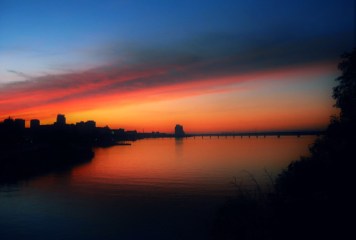
Sunset from Monastyrsky Island
So now it’s Odessa’s turn to undergo my mild-mannered and irrelevant scrutiny. Dnipropetrovsk had been fun, but a sort of challenging fun. A city that is in no way built for tourism, it’s grey, industrial and rough around the edges. With only one major boulevard, the centre is compact and – apart from on Sundays – mostly lifeless. However, there is an untapped beauty within it. For instance, while the city is a hollowed out former Soviet industrial stronghold, it also has sights like Monastyrsky Island, hugging the western bank of the vast Dneiper River, complete with forested parks, white sand beaches and – if you’re a fan of industrial landscapes – one of the most stunning sunset spots one could ever hope to see, underscored by the vast expanse of water surrounding the island, and punctuated by concrete bridges and shipyard cranes far, far in the haze of the distance.
Dnipropetrovsk is a city that I could never recommend to anyone I know. Nothing about it is conventional. There isn’t much to do, there isn’t much to see, but something about it left me with a sort of unspectacular love. And that’s still love, I guess, so it feels like it has to be qualified by something, but it isn’t. The emptiness, remoteness and unfamiliarity of the city are its drawing points.
I am perfectly aware that this knowingly-backhanded endorsement generously affords the average person an adequate arena within which to pick off reasons to avoid Dnipro at all costs, but that’s not really the type of person I’m selling Dnipro to. I write this because I know that simply by being in a place like this, Jake, Elliot and I are in a miniscule minority, even though I’m aware it comes across as perhaps a little overtly abstract to constantly try to put into words the perspective of someone who frequently finds himself in far-flung places purely because they exist. As a result, it’s difficult to explain much further, beyond saying the kind of fondness one has for a city like Dnipropetrovsk can only really be felt by those who have a love of travel off the beaten track – those who go somewhere simply so they can expect nothing and thus relish everything.
Japan is somewhere I have always, always wanted to go. Its location, its culture and its landscape have all played major roles in making me wish I could visit the Land of the Rising Sun since I was about ten years old. It always seemed so mysterious, intense and, most importantly, it looked like it would be so much fun. I know people who have been to Japan before – all of them unanimously praising this strange, demanding little group of islands in the Far East. And, more so than anywhere else I’ve been on this trip, I had people telling me how incredibly envious they were of my Japan jaunt.
And they’ve a right to be envious. It was quite an experience, and really has been the two most intense weeks probably of my entire life. But – and I’m sure you knew a ‘but’ was coming – I have to admit, I’m very glad to be leaving. I saw some amazing things in Japan. I rode the bullet train the entire length of Honshu, I climbed a mountain on an island in the East China Sea and I visited the sites of the only two nuclear weapons to have been used on civilians. I went to a karaoke booth, a pachinko arcade, a sumo arena and a million Shinto shrines. And, as I’m sure you’re aware, I love travelling, but this is the first in my life where I’ve really hit a limit. And I mean a serious, immovable brick wall of a limit.
In my first blog post from Japan I very briefly touched upon the concept of culture shock. Culture shock is something that I have obviously always believed in, and I thought I had felt it at various points in my life before. But after just two weeks in Japan, I now know how incorrect I was; I now know what culture shock really is. Japan is really hard work. And I don’t mean simply on a physical level, nor do I mean it’s simply a bit of a head-f*ck. I mean it emotionally.
No matter what walk of life you come from, no matter how much patience for other cultures you have or how much luxury you can afford to holiday in, I have a very brief PSA: Do not come to Japan alone unless you are very comfortable with your own company. This is not me attempting to exaggerate for humourous purposes either. That is a genuine warning. I’ve travelled on my own before. I’ve been to Canada, the US, Estonia, Latvia, Lithuania, Hungary, Finland, Serbia, Uruguay, Argentina, Chile, Easter Island, French Polynesia, New Zealand and Australia totally alone in the past few years, and every time they’ve been great fun. I’m very happy to spend time on my own, and I find socialising in hostels and bars pretty easy; in all the places I’ve visited, it’s been easy to strike a balance between meeting locals, meeting other travellers, and sightseeing alone if you need a little break. Japan, however, is not like that. First, let’s look at meeting locals. Actually rather than discussing it in depth, I can say two words to sum up your chances of that happening; good luck. Barely anybody speaks English, and those who do speak an incredibly limited amount. Moreover – and I’m sorry but it’s true – the cultural and social differences, for me personally, were just too vast. If I ever did come across a Japanese native my age who spoke a little bit of English, the conversation would stutter and die over and over again as we tried to find things we could both talk about. I think both of us would expect the other to have a frame of reference closer to our own, but in reality the UK and Japan are just worlds apart in so many ways.
Then, there’s meeting other travellers. I met some people in my Tokyo hostel just fine, cos it’s Tokyo and there are foreigners everywhere; you’re bound to meet at least a couple of people to grab a drink with, even if you do have to dodge the hoards of solo middle-aged white men who have decided that a youth hostel in Japan is the place they want to spend their remaining days before inevitably offing themselves. There were some great nights in Tokyo, wandering around until dawn, but in most other places (save one night in Hiroshima), the kind of people you’d actually want to hang around with were few and far between.
There’s a word that the Japanese use, ‘Gaijin’,meaning a westerner who comes to Japan. While it literally translates as ‘outside person’, in reality it’s often used in a pejorative manner; it’s used to describe people who come to Japan that are socially awkward or ‘weird’ in some other way. During my stay in Japan, jumping from city to city and hostel to hostel, I met maybe eight people – max – who were not ‘Gaijin’ in the truly negative sense of the word. The number of lisping, leery, lanky losers I met across the entire country was astounding. They’d turn up alone to Japan, just like I had done, but then either refused to socialise, or attempted to but just been too weird to hang out with. Don’t get me wrong, I can take a bit of weirdness as long as there’s some humour or self-awareness, but these people had no redeeming features. I felt for the ones who were so scared of socialising that they couldn’t get a sentence out without stumbling over every other word and sweating all over their crusty anime shirts. It’s good to chat to them sometimes because they can reveal themselves to be nice people underneath that awkward exterior.
But then there are the ones who you just wish would disappear. In Nagasaki, I checked into a hostel to a totally empty room. Awesome, I can make as much noise in the morning as I want (I had a 7am start the next day), and don’t have to wear my headphones for my music. Then, at 11:30pm, when I was in bed, a guy probably in his mid-30s with two lazy eyes came storming into the room and turned the light on. Nice entrance mate. I said ‘Hi’, to be polite, and he said, with a bizarre lisp, ‘Hi. Where are you from?’. A half asleep dude, in his underwear, in bed, with the light off – is really the guy you’re gonna go to for a chat right now? ‘England’. ‘Me too! Whereabouts?’. I told him I was originally from Brighton, but had lived in London for a few years. ‘Oh I’m from London too (I didn’t say I was from London) but I moved away. Where do you live? How expensive is it?’. Jesus man give me a chance. ‘I live in Dulwich’, ‘I don’t know where that is’. You’re a Londoner and you don’t know where Dulwich is? He continued ‘It’s just too expensive these days. It’s so nasty too, filled with foreigners, that’s why I moved to Slough.’
Ohhhhhhhh how I laughed internally. Though I didn’t crack a smile, it felt like I was about to have ten hernias at once; the veins in my head probably looked like the outside of Pompidou Centre. Sure, you can believe Slough is superior despite John Betjeman’s famous poem about how shit it is, but don’t call where I live ‘nasty’, just in the same way I didn’t laugh in your face when you talked about how great Slough is.
The conversation died and I turned over to sleep, only for him to suddenly continue; ‘Why are you here?’. I mean there are certainly better ways of asking that question, but I told him I was on a round the world trip, and that I’d done South America before here. ‘Oh I did South America too! What did you think of the girls there?’, he asked. ‘I dunno man, they’re just girls’. He replied ’Yeah but they were so easy. Everywhere I went they were so easy. So beautiful and so easy’. From the way this guy spoke, I could tell he was the kid people would give a dead leg for fun on the way to class, or a firm punch on the upper arm – there was no way this guy was drowning in girls in the manner he attested to. I also found it a little odd that he kept talking about how easy they were; that’s not a universal ‘guy-thing’ that’s gonna get me to respond. It just makes you sound insecure and fairly misogynistic. If anything, I’m gonna tell you to shut up because I’m trying to sleep, I’m not going to suddenly become Finchy from The Office and start making up bullshit stories about hundreds of Hispanic girls throwing themselves at me. I don’t travel for that kind of wannabe-macho crap. And anyway, I’m not exactly Ryan Gosling, but if that wasn’t happening to me, it sure as shit wasn’t happening to Captain Crosseyed over here. I told him I wasn’t really looking for that, and he responded with ‘Yeah but they’re Argentinian! All you have to do is talk. They love the English’. I think someone needs to go read a history book. The final nail in the coffin, the straw that broke the socially-inept camel’s back, was this quote from out of nowhere; ‘I love travelling in Japan because people aren’t common’. Huh? Not common? There are people everywhere, you meet them all the time. I had no idea what he meant, so I asked, and he said ‘Like common people. A lot of people can’t afford to come here so you don’t have to meet any common people’. Holy f*cking shit. My jaw on the floor, I sat there in total silence, staring dead at him, waiting for him to find a way to redeem himself after such an abhorrent comment. Yet, despite my reaction of horrified incredulity, he just paused for another 30 seconds before almost silently stuttering out ‘… y’know like chavs’. I got out of bed, switched the light off and went to sleep without another word.
Yesterday I made a gigantic balls up. My train from Nagasaki all the way back to Tokyo was booked for 14:20, arriving at 22:40. I got to the station early and asked if I could change to the 13:20 train instead, and I could, so now I was due in at 22:10. At my first of three interchanges, however, I had a 50 minute wait for my Shinkansen, so I got on an earlier one – I have unlimited rail travel so it doesn’t matter how I get around, right? Turns out the Shinkansen has a number of varieties, two of which are not covered by the JR Pass, including the Nozomi service. I accidentally got on a Nozomi bound for Tokyo, but after the first stop the conductor told me I couldn’t be on this train. I played the stupid foreigner card and he told me to get off at the next station. Ah well, I’ll just wait for my original train. I have no idea which station I was at, but after waiting around for 20 minutes, I stood and stared as my original Shinkanen – the one I was booked on – went zooming past at 200mph. Oh dear. I ran downstairs to check the timetable, and took my jacket off as it was so hot, at which point I realised I had also left my brand new hoodie on the original Nozomi train.
I threw my jacket back on, ran to the ticket office and asked what they could do about it. Turns out they could phone the individual trains. Awesome! But what happened next was such a comedy of errors on both sides that I was left with my head in my hands for most of the conversation. I told them I had left my black hoodie on the train. They thought I wanted to know when the next train was. I told them again what had happened. They thought I meant just a hood (I wouldn’t even know what this means). I corrected them. They thought I meant my jacket, and pointed at the jacket I was currently wearing, saying ‘but you’re wearing your jacket now’. I told them thanks for the astute observation, but that it was a black hoodie I was looking for, using wild hand gestures. They finally understood and asked where I was sitting. I told them I was in carriage #1, which I was. They asked which seat. I hadn’t checked this, but was in the very front row of the carriage, in the window seat to the far right, so said ‘1-D’, which logically makes sense, like on a plane. The little woman behind the counter phoned the train and had a long conversation. I stood and waited, feeling like I was watching my life draining away. She hung up and told me it wasn’t there. I said it literally had to be there. She asked again which carriage I was in. I said #1. She assured me that that’s what she had told the conductor on the train, saying ‘I told him to look in the first carriage’. I told her no, I meant carriage #1; the train had just reversed at Hakata terminal when I got on, so was running backwards, with carriage #1 at the very back of the train. She looked shocked, apologised profusely, and phoned again. I could see now that the next train I could get on was in 12 minutes, and I was quickly running out of time here. Again, she hung up and told me they couldn’t find it. I told them that was literally impossible as I was telling her exactly where it was. She deliberated for a minute before asking if the seat number was definitely right, getting out a little diagram of the seating plan. I pointed at the seat I was sat at, saying ‘1-D, right down at the front on the right’. She told me no, the seat I was pointing at was seat 18-A. I asked her how on Earth that could be right. She said that the train has reversed, so the seats have reversed numbers as well as the carriage, and the letters A to D have been mirrored to reflect travelling backwards. Thinking this was literally the most illogical, needlessly complicated system to ever have been used in a seat-numbering system, I put my hands on my knees in a sort of existential despair, and told her that yes, under that ridiculous system, I guess that must have been my seat. She phoned again, this time with an exceptionally long conversation. I looked around to see that I now had 4 minutes until my train. She hung up and asked me what colour it was. I told them, again, that it was black. She phoned again and hung up after two words, telling me that yes, they had found the hoodie. Did she really need to hang up in order to ask me what colour it was? Two minutes until the train now. I thanked her profusely and asked where I should pick it up. She didn’t understand me. I asked where I should collect it, making a symbol of ‘collecting’ with my hands, though I’m not sure what it must’ve looked like to her. She did understand me though, but then drew a total blank with her English, flapping her hands up and down. She obviously knew what she wanted to say but didn’t know the English for it. She said it in Japanese and I just looked at her with a face of panic and confusion. My train was now pulling into the station. One minute until it left. I shrugged at her, and she scrambled to get her phone out of her pocket. She opened Google Translate and frantically typed away. 30 seconds left. She turned it around to show me; ‘Osaka Station Lost & Found’. I shouted ‘Doumo arigato gozai maaaaaaas’ and went sprinting down the station concourse and up the escalator. I made it across the platform but the door shut on my suitcase as I was pushing it into the train in front of me. I wasn’t taking this bullshit so I just forced the door back open with my foot as a guard down the platform cried out in horror of my conduct. The doors closed behind me and I collapsed to the floor of the carriage, sitting there until I could catch my breath. I made it.
I got to Osaka after a few more train changes, short of breath and a little drunk after taking the edge off with a couple of Asahis. I had a full half-hour to make my connection, this’d be fine. I looked up at a sign reading ‘Lost & Found’, with an arrow pointing up, meaning forward. I walked forward and about 100m further down I saw another one, so continued walking. I walked for around five minutes until I had reached literally the end of the station. I walked outside for some reason in the hope it may be there, and was greeted by a bunch of taxi drivers shouting for my business. I ran back inside and headed back to where I had come from, where I saw another sign for lost property with a ‘down’ arrow next to it, facing the other direction. Turns out an ‘up’ arrow in Japan means behind you. So I frantically scrambled across the concourse with my now wheel-less suitcase until I found a small door with ‘Lost and Find’ written on it. I slid it open to reveal a guy sat behind a tiny desk, who immediately stood to attention.
“Black hoodie?” I said, hopefully. His response, in apologetic Japanese, indicated that this conversation may be rather difficult as he spoke no English. I made the same hoodie gesture as before and he asked where it was. I said it should be here. He gestured that he had no idea, but before I could reply he ran off and grabbed a colleague who could speak limited English. “Where you hoodie?” he said, to which I frustratedly replied “Here! It should be here!”. They both made a simultaneously inquisitive hoodie gesture to check that I was definitely on the same wavelength. They told me no and there was nothing they could do. I told them the other guys said it was here, to which they told me it might be in Tokyo. I said I don’t have time to collect it in Tokyo. They said they’d send it to me. I told them I was leaving Japan the following day. They told me they couldn’t ship internationally. I told them I knew that as there was a giant sign behind them stating that exact clause. They said “Hoodie?” one more time, to which I said “Yes! A hoodie! In Osaka! It will be here!” to which the guy suddenly went “Ah!”, and disappeared for a second into a side door before returning with my hoodie in hand.
I mean seriously guys, what the Christ. You had it all along and I’ve been stood here for 15 minutes with you telling me it’s in Tokyo?! Jesus. I thanked them and again found myself sprinting for the train, making it with around 30 seconds to spare this time. Phew.
I’m in Singapore now, so will report more from here maybe tomorrow, but for now, that’s the Japan portion of my trip done and dusted. I am so exhausted it’s not even true. While it was experience I will never ever forget, it’ll also always be one that I would heed many words of warning to others before attempting. It’s hard work.
Nagasaki is very, very different to Hiroshima. There’s not a chance in hell I’m going over all the stuff I talked about in my last post, but there are a number of things about this city – particularly in regards to its history – that I find a little… unsettling.
I’m currently bolting out of Nagasaki on the Kyushu Line, to join the Shinkansen back to Tokyo at Hakata. That’s a nine-hour train journey right there, so plenty of time to reflect on the four Japanese cities I’ve seen in my time here. To sum it up succinctly, Tokyo was insane, Kyoto was beautiful, Hiroshima was peaceful, and Nagasaki? Well Nagasaki is a total enigma. First off, it’s not particularly pretty. It’s surrounded by some spectacular mountain landscapes, but the city itself is mostly concrete with the odd cobbled street thrown in. Kyoto, untouched by the war and full of ancient shrines, has a mysteriously likeable imperial feel to its aesthetic set-up. Hiroshima too had an almost-Scandinavian quaintness to it with small sidestreets, tree-lined avenues and a calming atmosphere. Tokyo is a sprawling monster of a megalopolis but even that had a certain something about it, just by the sheer force of its visual intensity. Nagasaki, meanwhile, is nothing to look at. Though the natural bay it sits in is absolutely stunning, the fact that it sits here also means it’s a big churning industrial port that never sleeps – its proximity to both China and South Korea means gigantic ships come and go at all times of the day and night. Combine that with a city centre that is about as grey and boring as possible and you have a pretty boring city aesthetically.
That is not to say that the city itself is boring. Far from it, in fact. And yet, it’s the first place I’ve been that I’m not sure I’ve liked because of that fact. Nagasaki constantly keeps your mind ticking. Sometimes it’s when you’re going up the side of a mountain in a cable car, sometimes it’s when you’re getting a boat across the harbour, and sometimes it’s when you’re near anything related to the bomb.
Oh, the bomb. How much you have ruined this city. Not only am I sure it was once a pretty little harbour town, but I’m also sure it was once populated by sane people. The bomb changed both of those things. Remember how I said it felt like Hiroshima had come to terms with their bomb and had moved on to promoting peace? Nagasaki pretends to do the same, but it’s total bullshit and I don’t buy it for a second. I don’t mind this city as there’s enough to do aside from bomb-related things, but anything regarding the bomb just made me furious.
Before I came to Nagasaki, I met many people in Japan who said they’d also liked to have gone but that it was too far away, or they didn’t have time. I met one person who heard from someone who heard from someone who had once gone, that Nagasaki is still very angry about the bomb, in a way that Hiroshima isn’t. I thought that couldn’t really be right, and that it was just something people would say because nobody else has been to Nagasaki to prove it. But holy shit were they right. The Nagasaki Atomic Bomb Museum, which is far more developed and flashy than its Hiroshima counterpart, is like – and I’m not joking – stepping into North Korea. It is so laden with anti-American sentiment and cloying, sentimental, self-pitying bullshit that I literally couldn’t believe they were getting away with it. We all know the bombing was a bad thing, whether it ended the war or not. Even if it was our best option and gave us the optimal conclusion, that doesn’t mean it was a good thing. Yet the museum at Nagasaki acts as if the Allies dropped the A-Bomb for shits and giggles, like they were all sitting around at Potsdam chuckling to themselves over their brandy until Churchill got drunk enough to dare Truman to drop it on Nagasaki.
What this museum did that Hiroshima’s did not do was discuss the context of the bomb. Or at least it attempted to; it had a giant wall devoted to a timeline of the history of the atomic bomb, but it only showed the progression of the Manhattan Project, not its correlation to the war. If you didn’t know already, it would have looked like the Americans were just blowing shit up in the Nevada desert for fun and then randomly dropped it on Japan for no reason. The timeline made it look like there was no war.
Or that was until the last panel. Two big photos sat side by side; one of Harry S. Truman, the other of US Army General Thomas T. Handy. Handy’sphoto had a big caption that pointedly and accusingly read ‘Thomas T. Handy – the man who gave the order to drop the bomb’. Truman’s photo was captioned with a quote from just after the bombing; ‘We have used [the bomb] in order to shorten the agony of war, in order to save the lives of thousands and thousands of young AMERICANS‘. Just like that, with the word ‘Americans’ emboldened and capitalised, as if to say ‘Look at these evil allies, only caring about themselves!’. It’s war, genius. Every man for himself.
Don’t get me wrong, I totally appreciate the gravity of the situation being discussed here. As I stated earlier in the week, the bombs indiscriminately killed hundreds of thousands of people. It is both morbidly fascinating and stomach-churningly disturbing to look through the artifacts laid out in the museum, like the row of children’s lunchboxes that have been melted, or bone fragments fused to brick, a two-foot thick iron girder bent out of shape like spaghetti. It really hits home the insane destructive power of the bomb, and highlights that yes, we really did make people suffer and that is something that can never be erased from history.
Yet if you were to look at from the other side, using this museum as a proxy, you’d think it was all for nothing. By playing itself up as the victim, Japan whitewashes its history leading up to the bomb. We bombed Japan because the Japanese were refusing to surrender. We dropped the bomb because, whether they agree with it or not, we truly believed we would be saving more lives. I understand it seems like ‘special treatment’ in a negative way, because it was; that type of bomb should never have been used on people.
But Nagasaki isn’t interested in what we think. Hiroshima, with dignity and patience, debated the morality of the bombing with great philosophical endeavour and intelligence. Nagasaki comes out all guns blazing. Hey look at this photo of a kid with a melted face. Hey look at this letter a mum wrote to her dying baby. Hey look at this really sad testimony of a man whose wife died. I don’t come to museums to be told what to think, thanks. I know enough about this subject to know that the curators should have been far more restrained and respectful – by showcasing images of the dead in such an exploitative, tasteless fashion it not only degrades the subjects, but negates the whole point of discussing the bomb at all. If you cannot internally debate the ethics of the bomb, you should not talk about the bomb, full stop.
And then on to what I found to be the most outrageously offensive thing about this museum; its patrons. I was the only westerner in there, which is fine – you’re the only westerner in most places you go in Japan. That’s not the issue. The issue is this; at Hiroshima’s museum, we were stood around looking at a scale model of the city, with coloured lights being flashed onto it to denote shockwaves and fireballs etc, to demonstrate scale. Everyone stood hunched over the model in concentrated, respectful silence. Put the corresponding Nagaski model in the museum in that city and what happens? A bunch of bullshit is what happens. In the most absurdly un-Japanese fashion possible, the room turned into Kim Jong-Il’s funeral; gasps and yelps of despair suddenly lit up the room just as the spotlight lit up mini-Nagasaki in a bright orange glow. I looked up to discover that all of the women and girls present, which comprised just over half the people standing around the model, were crying.
This is a scale model of a city with a light on it. Save your crocodile tears for the photos of dead babies if you’re going to so openly play your victim card. I do not care how heartless any of this sounds – I’m not having this melodramatic nonsense – and if you were there you too would’ve seen how incredibly fake it all was. Although it’s a bit odd to say, I think realistically we all know what real crying sounds like, and trust me, this was not it. Also, this model city is the first thing you come across as you walk into the museum. It’s literally 5ft inside the front door, and already you’re all bursting into tears of grief? Looks suspiciously like you turned up ready to cry on demand, considering literally every single Japanese person in the museum at Hiroshima could keep their emotions in check; even if they secretly wanted to drop a million bombs on the US as revenge, they quietly wandered about, respectfully observing the exhibits and not openly showcasing how they felt about it. Funny how they managed that while you guys in Nagasaki couldn’t make it three strides through the front door before having a public breakdown.
And so I walked around getting a lot of something I would end up getting rather used to; the death stare. From what I could gather, and perhaps understandably, Nagasaki-ites don’t like Americans. Problem is, they also appear to think that anyone who looks vaguely western is American. I would walk around town and talk to people in shops/restaurants, and most would either shoot me a look that could kill a man, or ask me if I was American. Yep. Not ‘Where are you from?’, but ‘Are you an American?’. I got this maybe seven or eight times during my time here. I would always say ‘No. I’m English.’, which usually brought about a big smile of relief and an ‘OK!’ symbol with their hands (like we had nothing to do with bombing). However, when a cashier at a 7/11 in town frowned at me as I got to the counter asked me the same question again, I lost it. You’re working in a chain convenience store, don’t ask your customers shit like that. ‘Are you American?’ echoed down the noodle aisle, and with a big smile on my face, I said; ‘No I’m not a goddamn American but I can become one if you don’t mind your own business and serve me the coffee I asked for’. He had absolutely no idea what I said. I don’t really have any idea what I meant. There was a pause, and with a look of defeat I said ‘English’, to which his face suddenly exploded into a grin – ‘OK good!’ he exclaimed and he ran off to get my coffee. Good? It’s good that I’m English and not American? I’m loathed to be too self-righteous about this sort of thing, but if the positions were switched and I said ‘Are you Korean?’ and was visibly relieved when he told me he was Japanese, wouldn’t that be considered fairly racist?
Back in the museum, I was reaching the final few exhibits. I got to the end of the interactive exhibit room where I found a small corner with a couple of touchscreen TVs in it, and a series of buttons numbering 1-5. I looked up at the contents. Button #3: Sino-Japanese War. Aha! I’ve finally found some discussion of historical context for the bomb.
‘… the hard-fought war between Japan and China continued as Japan took more territory from the Chinese, culminating in the Japanese taking the city of Nanking, where they committed a massacre’.
… That’s it? Seriously, that’s all you can say about the Rape of Nanking? You can devote an entire multi-storey museum to the suffering caused by the atomic bomb, but all you could muster up for one of the worst war crimes in the history of humankind is half a sentence on a screen hidden in the corner? Oh yeah you looooove going into gratuitous gruesome detail about the things we did to you, either beating your chest as a show of nationalistic defiance or weeping like little bitch, but when it comes to your atrocities, you hurry the narrative along as it suits you. Tell me, where are all the women from earlier? Why aren’t they here, huddled around the screen, crying for the rape, torture and murder of hundreds of thousands of innocent Chinese men, women and children? Where are their tears now? Seems like their tear ducts dried pretty sharpish.
The bomb caused unimaginable pain, suffering and heartache. As someone born in a country that was on the opposing side to Japan and facilitated the bombing more than any other country outside the US, I am openly willing to admit that. It was awful. Of course it was, and it was our doing. But why can’t this museum treat me with the same respect? To this place, the bomb was 100% wrong, the Rape Of Nanking is just a footnote, and the Americans are the very essence of evil. If anything it was that very brutality that the Japanese military showcased in China that led to the dropping of the bomb in the first place; by looking at past behaviour, Truman could tell they weren’t going to give up without drastic measures being taken, even if they were on their last legs by August 1945. They were going to fight – mercilessly so – until all their soldiers were dead.
And yet, what really hurt me more than anything was that the people that were crying the most, and making the biggest show of their grief, were my age. Mid-20s at the oldest, early teens at their youngest. What were they weeping for? I bet their grandparents barely remember the bomb, let alone them or even their parents. By contrast, the two oldest people in the museum- the only couple present who looked old enough to have potentially been able to remember the bomb – did and said nothing. They just observed silently.
To me, this symbolised a really dangerous precipice that Japan is sat on. As I said in my last post, the Japanese education system has faced criticism recently for whitewashing Japan’s war crimes out of its national curriculum, including the events at Nanking, and the infamous Unit 731. Were these kids, stood across the room from me, not being told about these things? And what sort of bizarre nationalism had they been force-fed to persuade them to stand weeping in public in such an incredibly inauthentic fashion? It was an absolutely surreal, confusing and, above all else, grossly insulting sight.
And on the flip side, the museum was always going to be fighting a losing battle trying to make me feel guilty. I’m the same age as the people with tears streaming down their face at what they perceive to be a great injustice – born a full 46 years after the bomb was even dropped. My country might have dropped the bomb, but I sure as shit didn’t. I mean Jesus Christ, I shouldn’t have to say it but it would be the same as me expecting a German my age to feel guilty about the Holocaust. I’m self-aware enough to know it would be an utter embarrassment to even think that, and it is that exact lack of arrogant self-awareness that will forever taint this museum in my memory.
The city of Hiroshima has come together as a community, and tried to heal its wounds with a graceful acceptance of the horror of the Second World War. Nagasaki has done no such thing. Nagasaki was handed an unenviable place in the history books, so it ripped out the page, burned it and wrote its own. I hurried through the remainder of the Nagasaki propaganda museum, gave back my headset, went the memorial hall, bowed to the cenotaph (I’m not going to hold this museum’s twisting of the truth against those who were killed), and promptly left.
* * * * *
Part II: Big Man
Awesome technique on the skins
One thing Nagasaki definitely has going for it is trains. Being positioned at the very far western end of Japan, you’d think it’d be a simple one-line terminus. Oh no. Nagasaki’s got a bunch of lines branching off all over the place. Including, I discovered, the Ōmura Railway, a cute little two-car train that runs up and down the northwest coast of the island of Kyushu. Which, as it turns out, is absolutely spectacular. I discovered that in the period after the war, the US had an army base in the small seaside town of Sasebo, about two hours up the coast from Nagasaki by train. In 1950, they officially introduced the burger to the Japanese. As a result, it’s now known as ‘Burger Town’, and has a group of restaurants that all make their own special burgers. Hungry and a little bored, I took the coastal line all the way up to Sasebo to check out what it was like (plus after the museum I was not in the mood to hang around Nagasaki until I’d calmed down). The Ōmura Railway, leading from Nagasaki, snaking around Ōmura Bay to Sasebo, is one of the most scenic train journeys I’ve ever been on. Looking out across the water to the mountains on the far side of the bay was a sight to behold, punctuated by tiny little fishing towns with a one-way train line meandering through them.
Someone locked the Colonel in at 3am
Then I got to Huis Ten Bosch. Yes, despite being a ‘town’ in Japan, it has a Dutch name, but all will become clear in a moment, for Huis Ten Bosch is maybe the weirdest example of Japanese audacity and abnormality I had seen so far. Listed online as a theme park, it has no real attractions. Instead, it is an exact replica of a Dutch town. With shops. And restaurants. You pay £40 to get in, and then you’re just… in a town. It’s like a holiday for people who can’t pay to get to the Netherlands. Balls to paying that much, so I just peered in as we skidded past on the train – it was absolutely bizarre. Little cobbled streets, a neo-gothic clock tower, and a palace modelled on the Huis Ten Bosch Palace in The Hague, Netherlands. What on Earth was the point in this? Well, I looked it up, and it was something along the lines of ‘to strengthen ties between the two nations’. Really? You could just hold a meeting of leaders or do a state visit, you don’t have to go batshit insane and replicate an entire town. It’s like the diplomatic equivalent of a serial killer tearing off someone’s face and wearing it as their own.
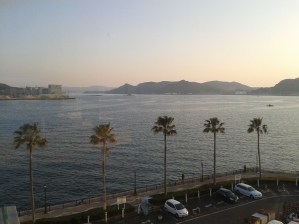
Sasebo Harbour
I got to Sasebo, which is a fairly unremarkable little town, and found a ‘burger map’, listing each place and their speciality burger. I chose one called Big Man, simply because of its name, which did a bacon & egg burger with special homemade Japanese mayonnaise. My kind of burger. I wandered over to discover that it was a tiny little place with about four places to sit. I took the only available seat and had my truly excellent, juicy burger with some fries on the side and a pot of their mayonnaise for them. Holy shit that mayo. It was absolutely spectacular. I’ve only ever had better mayo in Belgium, and that is saying something. Who’d’ve thought the most remote corner of Japan would be the home of mayonnaise that bloody good? I certainly didn’t, but by sitting in Big Man with my fantastic food, overlooking the harbour as the sun went down, I had given myself one of the highlights of my trip.
I also decided that I would spend all my time in Nagasaki alone. Which has been quite fun, but also pretty challenging. Very few people speak English in Japan, and even fewer do in Nagasaki. Plus, romaji, Japanese written in the Latin alphabet, is pretty much nowhere to be found around here, so I can’t even tell where I’m going or what I’m doing most of the time. However, every once in a while you find some English translations that are absolute gems. I found a pachinko arcade (a type of Japanese gambling arcade) with this written on the front door;
“Ladies and Gentle man,
Buckle your belt, the adventure is about to commence.
It is in our nature to serve you with excitement and your fun,
so we will be learning much about the universe in this place.
What joy! What fun! What good! Enter at once!”
It’s an arcade, not the space shuttle. Relax. Trust me, you have no idea how much I wish I’d gotten a photo, but my phone battery was too low. I had to hurriedly write it down on my arm with a pen from my laptop bag for all to see. Also on that note when I was in Kyoto I had a subway map that accidentally referred to it as the ‘Kyoto dubway’.
Hashima Island
This morning I had to get up at retard o’clock to make my reservation for a tour of Hashima Island. Hashima Island (also known as Gunkanjima – ‘Battleship Island’) is a miniscule-yet-notorious island about half an hour off the coast of Nagasaki. In 1810, this tiny little lump of land sticking out of the Sumo-Nada Sea was discovered to be totally surrounded by undersea coal deposits. By the end of the century, it had been developed into a huge mine, contained around 5,000 workers, and the island had been artificially expanded to about three times its original size. In order to house the workers, Japan’s first ever high-rise apartment blocks were built on the island. At that point it had a population density nine times that of Tokyo. This island is literally about 100ft x 400ft. For 5,000 people to live there is crazy. Then in 1974, due to a mixture of coal going out of fashion and it being an insanely dangerous mine stretching to 350m below the seabed, it was closed. The workers moved back to Kyushu, and the island was abandoned. And it’s stood like that ever since – a partially-ruined mess of apartment blocks, mine shaft entrances and shrines. Half the buildings have collapsed, and the remainder are just concrete shells. Pretty cool stuff.
In fact, so cool and such a part of the country’s industrial history is the island that in 2015, Japan submitted it to UNESCO for approval as a World Heritage Site. At which point South Korea and China both went ‘Hey isn’t that the island where hundreds – if not thousands – of Chinese and Korean forced labour workers were kept under appalling conditions?’, to which UNESCO responded with ‘Yo Japan is this shit true?’. Japan offered a half-hearted acknowledgement of the issue, and that’s all UNESCO needed; they passed it later that year. I should probably add that North Korea also took issue with the proposal, but North Korea bitching about forced labour? Gimme a break. Then again you could probably say the same of China. God, who knows.
Abandoned stuff
The island was cool, to be fair. It’s a little expensive to get to and the sea on the way out is choppy to say the least, but it’s still worth seeing. One problem is that you absolutely cannot stray from the guided group, and you can only stand in three designated ‘viewing points’, all of which are squished at the western end of the island. Which reminded me of how, when I was in Tallinn, Estonia, I went to Paterei Prison, which was surprisingly similar – an abandoned former prison that was left to ruin – you could pay €3 entry to just go in and mess around. You could go into any building, climb any ladder, walk on any rooftop. Nothing was off limits. I mean, the Japanese approach is the more sensible, but be honest, which sounds the more fun?
Lo and behold, neither my guide, nor the English-language leaflet I was given on the island, mentioned any form of human rights abuses. What a surprise. They just talked about the depth of the mine, the danger of working in it, and the living conditions, which they seemed to suggest were rather good. Buuuuullshit my friend. I personally loved this note from the leaflet;
“Completed in 1958, the Hashima Hospital and Quarantine Ward was built to protect the health of the mine workers who risked their lives in the pit, and the families living on the island. For the people on Hashima, the existence of this hospital was undoubtedly reassuring.”
Oh yeah I can just imagine being kept to do forced labour on a shitty little concrete island, thinking ‘well at least if I get hurt doing this incredibly difficult and dangerous job I’m literally being forced to do, I’ll be saved from the sweet embrace of death!’ Also ‘their families on the island’? Somehow, I doubt the Chinese and Korean workers were that lucky. I also get the feeling these workers probably didn’t feel the full benefit of what was – according to the leaflet – the extremely beautiful, calming rooftop flower gardens on the island. We sped back on the boat across the sea, making some nice jumps on the way. I got to the harbour, went to the hostel to pick up my suitcase (which now has no wheels rather than one), and, after an epic slog across town, carrying the suitcase on my head, I got on the Shinkansen.
And so ends my time in Nagasaki. It’s been weird and wild and I’ve had a lot to say about it. The night view from the top of Mt. Inasa was mind-blowing, Hashima Island was intriguing, and the museum was many things, but at least it wasn’t boring. One more night in Tokyo, then I fly to Singapore. I’ll do another blog post as a perspective piece on my experience of Japan as a whole before I leave.
My boy Isaac modelling with the limited edition cherry blossom Asahi can.
Japan is proving to be hard work in more ways that I had originally predicted. While talk of Tokyo’s notorious intensity and extremely crowded nature both rest on fairly well-trodden ground, they are actually fairly inconsequential features of a city that literally could not be more indecipherable as a Western tourist. I don’t understand any of it. While it certainly does possess a looming intensity unmatched by any other city on Earth, that’s not what makes Tokyo a challenge – it’s the much smaller things.
The Japanese, as many of you will know, are fiercely nationalistic and isolationist. That is obviously not to say their patriotism spills over into aggression; they have remained one of the world’s most outspoken pacifists since 1945. However, there is an obvious, almost tangible sense that the Japanese are aware of their remarkable technological and infrastructural advancement, and thus, like I’m sure many Americans would, believe everything they do is how everyone should do it. As a result, there is extremely little room for negotiation and even less room for compromise, and thus people visiting Japan may either struggle to get to grips with various facets of Japanese life, or may find themselves getting frustrated at how illogical some of it seems to an outsider.
Some things frustrate me massively. The most notable example for me personally is that the Tokyo subway system, though extensive and metronomic, is an absolute shambles. The layout makes no sense, the trains are ridiculously slow and uncomfortable, the platforms are all about a mile apart from each other if you’re changing lines, and most annoyingly, there are lines in on the platform that denote a queuing space for each door. If you don’t stand in it, people act like you’re a bellend and give you dirty looks. Then lo, the train arrives and the queue falls apart, only to be replaced by a crazy shoving free-for-all, the likes of which I’m sure would also be the end result of not having this stupid queuing system in the first place.
Another example would be the country’s attitude toward smoking. I sat down at a restaurant on my first day here, only for the guy next to me to suddenly get out a cigarette and start smoking away. OK that’s a pain, it must not be regulated here, I thought, but no; I stepped outside to head home after eating, only to see signs painted on the floor saying ‘Do not smoke in public!’ and ‘No smoking on the street!’. What in the hell? You can smoke into my face in a dingy little hut while I’m trying to enjoy a bit of ramen but you can’t smoke near me when I won’t actually be inhaling it? As Frank Costanza once said, ‘well that’s perverse’.
But beyond moments where I find myself getting simply worked up about stuff that confuses me, there are moments where I find myself in hysterics as a result of that wonderful occurrence we all know and love when in countries with a massive language barrier; the misunderstanding. Two have stood out for me since being here. The first was two days ago, as I was attempting to buy some food. There’s a weird little self-serve shop around the corner from my hostel, where you can fill up a container with all sorts of strange food, and they price it based on weight. I stocked up on my fair share of something chicken-y, something tofu-y, something with potatoes and garlic, and then a cheeky scoop of prawns. I handed it over to the cashier. 599 yen appeared on the till. That’s about…. £3.50 I think? Either way, Japanese yen coins come in varieties of 500, 100, 50, 10, 5 and 1. One yen is absolutely useless and I hate having them on me, so I handed over a 500 and a 100 and bowed, extending my hand, gesturing ‘keep the change’. He nodded like he’d understood. I left the shop and realised I had a train to catch and was running later than anticipated. I started running, at which point I heard someone shout something behind me, but it was muffled by my headphones, so I kept going. I got maybe 150m from the shop, but I was being slowed down by my luggage, and behind me the shouting was getting louder. Confused, I turned round to see the cashier, who, having thought I’d forgotten my futile one yen change, had run down the street after me shouting ‘One yen! One yen!’, though obviously he was not aware of the ‘y’ sound at the front of the word ‘one’, so to any English-speaking onlookers it would have looked quite a lot like I was being chased down the street by a lunatic in a chef’s uniform shouting ‘ONION!’ at me. He gave me my change, gave me an extremely apologetic extended bow. I said ‘Oh, arigato gozai mas’ (‘thanks very much’), to which he softly repeated ‘… onion’, and headed back to his shop. I threw the coin in the bin and continued running.
The extent of Tokyo’s St Patrick’s Day celebrations. Three days after St Patrick’s Day. I have no idea either.
The next night came another misunderstanding. Me and a group of people from my hostel decided we needed to head out to grab some food, so we walked up towards Asakusa to find somewhere. Asakusa is fairly touristy due to its proximity to the Tokyo SkyTree and the local shrine, so we passed a number of restaurants that looked to be closer to the higher end of our respective budget, until we stumbled across a strange building, the likes of which you see fairly often in Tokyo. Rather than having a restaurant district or area filled with different places to eat, you’ll often find one building with nine or ten floors, with a different restaurant on each. The one we found had nine restaurants and after much deliberation we decided on the third floor. After Finn, my hostelmate, smacked his head on the ceiling attempting to navigate a flight of stairs, we entered, taking our shoes off and putting them in the usual shoe-locker arrangement, and sat down. After a few beers and a couple of octopus balls, we noticed a small sign on the wall advertising a ‘sushi roulette’ plate, where you get a plate of sushi, one piece per person, and one of them will contain a large amount of wasabi and, presumably, blow your head off if you get it. However, it didn’t quite work out like that. We pointed at the sign as the waiter came around, and he attempted to ask how many we needed. So we said five, one for each person. He looked shocked, as if it was way too much. We assumed he thought we meant five plates, so we said ‘Oh OK just one plate’. Cut forward half an hour (seriously how did it take this long?), and the waiter reappeared, holding a plate high above his head. With great anticipation, we watched as he lowered it to reveal… one piece of sushi. This wasn’t sushi Russian roulette, it was sushi suicide. Or so we thought, until Finn took the hit to reveal it was a non-spicy piece. In one fell swoop we had gone from sushi suicide back to Russian roulette, but this time with a toy gun.
Apart from generally soaking up Tokyo’s omnipotent saturated nonsense, the only other thing I’ve done of note was visit the Golden Gai with two people from the hostel. One of the strangest places I’ve ever had a drink, the Golden Gai is a row of six tiny alleyways in the Shinjuku district, all crammed with pubs and bars barely bigger than a toilet cubicle. We found ourselves in a sort of treehouse/lookout above a tiny bar, drinking pint after pint of Kirin (with the occasional sake which I don’t remember being quite so disgusting). One missed last subway home and one strange decision to walk across the entirety of Tokyo until 6am while still drinking later and I ended up still very drunk when I was woken up at 11am by a little hostel worker telling me it was my time to check out. After almost falling over in the shower I decided I would sit downstairs and eat sushi until I stopped feeling like I may pass out.
A failed attempt at a timed selfie
Today I’m heading to Kyoto. In fact, using my Japan Rail Pass, I’m currently on the bullet train as I write this, in the shadow of a snow-coated Mount Fuji. I’ll be honest, this is pretty awesome; in fact, when I set foot on the train and the electronic ticker at the far end said ‘Ladies and gentlemen, welcome to the Shinkansen’, I’ll admit I got goosebumps. In all honesty the train is rather simple; sure it’s fast but really it’s just like any other commuter train. Although, it is also complete with an absolutely insane seat reservation system that makes no sense. I’m not even going to explain how little sense it made. That’s how little sense it made. Long story short; three hour train journey having to change seats five times.
Also on the way to the station a wheel fell off my suitcase while I was eating sushi. A low moment. I now carve a line through every neighbourhood I drag my suitcase through.
Will report more from Kyoto once I’ve had my next helping of ramen. And maybe a nikuman. Look it up.
Oh hey Waitrose Essential mayonnaise, glad you could make it
A well-known aspect of Latin American life is its capacity for delays, lateness and a generally relaxed attitude toward schedules. In Argentina and Uruguay, I often found myself idly sat by as buses refused to turn up, or as meals took 50 minutes to arrive. In Chile they bumped this trait up a gear; someone would arrange to meet you at 6pm, then turn up at 8 or 9 and act like nothing’s wrong. However, today I sat foot on the mystical land of Easter Island. Known for its Polynesian quasi-religious statues (Ahu) and its rugged landscape, it has built a reputation as one of the world’s most remote island resorts, and seemingly, the world’s slowest.
Nothing happens on time on this island. Nothing. My flight was delayed taking off and subsequently delayed landing, which was a pain, but nothing compared to the shenanigans at Matavuri Airport. The dudes who bring the stairs to the plane took 20 minutes, the baggage reclaim took an hour and a half, and the guy giving me a tour of the campsite here (yes camping kill me now) thought I needed to know literally everything about the facilities, including the mechanics of a washing machine and what a bicycle is. So despite being checked into a campsite literally 100 yards from the tiny little airport, it took three and a half hours before I could actually begin to explore, and explore I did.
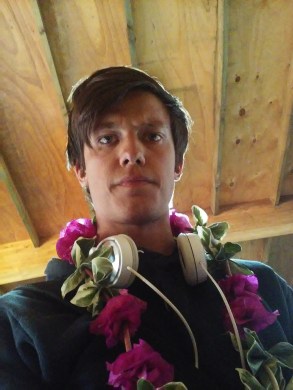
My very own floral wreath at the airport
I’ll be honest, Easter Island is not a tiny speck of land in a vast ocean of nothing. Well I mean from a relative standpoint, it obviously is, but when you’re here it’s not quite like that. First off, it’s not that small. It’s not like some random bit of rock like the Pitcairn Islands; it has enough space for four different volcanoes, three national parks, and a coast road featuring 28 sets of Ahu.
Speaking of which – due to the lack of any English speakers at my campsite – I’m kind of alone here, so I headed off to the beach last night, as I’ve heard great things about the sunset. On the way a convoy of motorbikes passed me, with all riders wearing Nazi helmets. Oh so you can’t import any decent wine but you can import a bunch of goddamn Nazi helmets? The strangest thing about this sight was the direction these eight men were going – north, up into Terevaka, the massive volcano that dominates the skyline here. At 9pm. What the hell were they doing? Is this a conspiracy theory come true? Maybe Hitler never died – maybe he’s hiding out in a volcano lair on Easter Island.
But anyway I got to the beach and witnessed a pretty amazing sunset, and I realised, going back to my earlier point about isolation; you just can’t feel it. Sat at home in England, you might think ‘God wouldn’t it be amazing to escape to somewhere that remote?’. On paper (and more specifically on a map), islands such as these are an inviting if costly prospect. A dot of land surrounded by nothing for literally thousands of miles. But when you’re here? It just feels like any other coastline. It may be obvious, but the horizon curves beyond view after a certain point, so you might as well be sat looking out at the Atlantic, or the Bering Strait, or even the Channel. France could’ve been just over the water for all I cared.
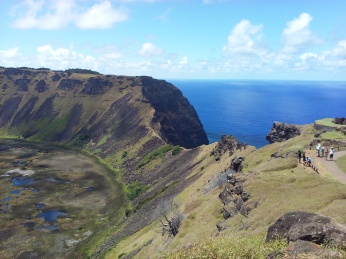
Swampcano
Another expectation that I was also sucked into but turned out to be false is a belief that you’ll be able to get into and understand the isolated island lifestyle through witnessing others and experiencing it yourself. You’ll see that the people here do things differently; they’ll be more relaxed, friendlier, less ‘corrupted’ by outside influence. But I have to report that it’s bullshit. It’s part of Chile, and that is a very obvious fact. Call me naive for having expected it in the first place, but nobody speaks any form of Polynesian language, I’ve only met two true islanders, every single sign is in Spanish, it is absolutely jammed to the point of bursting with Chinese tourists and – most notably – it just is part of Chile. Same food in shops, same beer in bars, same terrible radio, same currency, same everything. The only things that are slightly different are the time zone and the landscape. Also, strangely, none of the restaurants or supermarkets have their own customised signs. Instead they all have these weird pre-made wooden signs featuring a big Coca-Cola logo and an empty space where you can write the name of the restaurant. Now that is depressing.
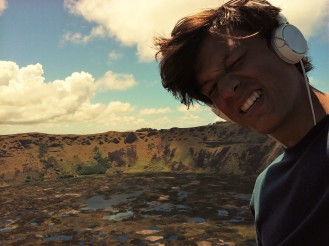
My failed selfie at the Swampcano
Speaking of which, I went to a bike rental place earlier today and got myself a little mountain bike for 24 hours for £10. I looked at a map with the rental guy, and he pointed to Orongo, a national park squashed in the southwest corner of the island – the only area south of the monumental airport runway that cuts across literally the entire island. Telling me not to jump the gun and go north, he suggested I take a quick bike over to Orongo. See the ancient houses, see the little islets off the coast, and of course go to the volcano and have a look. I owe this man a slap in the face. This is not cycling terrain. It’s a shitty dirt road stretching almost 10 miles uphill to the top of the volcano. With no shade. In this heat. Why this rental guy thought I had a look of the Bradley Wiggins about me as I managed to drop the bike and subsequently dislodge the gear chain while attempting to simply walk out of the car park baffles me. So I’m back at the campsite now. I have to admit, the cycling back down was awesome. Even when I had to kick a cow that charged me, still fun.
I’ve finally recovered from La Serena. Not in a wild party way, but in a nagging cold that I inexplicably had all the time I was there. I got an interesting moment as a leaving present too – me and Benjamin (a fellow hostel worker) were making beds, when I grabbed a blanket to lay across the top and a gigantic spider jumped out of it. Now I know I’m not exactly Australian, but I’d never seen a spider this big. It stumbled around the room for a bit until the cleaner came in and (in hindsight quite ironically) didn’t hesitate to stamp on it. This wasn’t a small little speck stuck to her shoe – she lifted her foot to reveal a large black stain on the floor, with a couple of legs left behind. She sighed, then continued to make beds. Her nonchalance made my day.
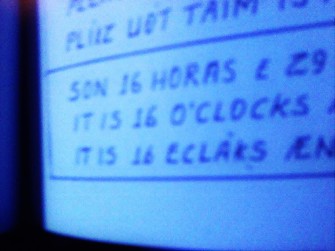
Were you aware that it is 16 ecláks?
The next day I headed south on a bus, my upgraded semi-cama (‘half-bed’) feeling just as uncomfortable as I had expected when I handed over an extra £2 to book it. Had a beer, had a Taco Bell, and got in an overpriced taxi to the airport. I had a kind of semi-argument with the driver before we got in about the price, saying that last time I’d paid £7, to which he laughed at me. I almost considered not getting in but it was late enough for me not to care at this point. Whatever. Once I’d got in, I realised I had landed another strange driver, like Bruno all those weeks before. He asked where I was from, I said England, and he handed me a small blue book. It was a clearly very hastily-made Spanish-English dictionary, bound together with bits of string. He handed it to me so I could start a conversation, but I was way too distracted by the sheer number of incorrect translations in there. Almost all of it was wrong.
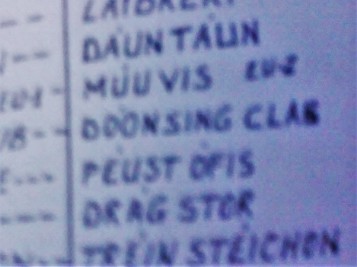
Mate have you checked out that new dóonsing clab in town?
‘What time did you arrive?’ came out as ‘How long did you be?’, ‘How much will the trip cost?’ was ‘How much are this carriage?’ and I also enjoyed ‘I am going to the airport for my flight to ___’ becoming ‘I am gliding from airports in the ___ flight’. Another interesting facet was the English phonetic pronunciations. I didn’t get many photos as my phone camera is atrocious, but you can see some of them in this post. The driver attempted to speak to me but the backwards translation made it difficult to find what I was trying to say in English, so the conversation was frustrating and didn’t last long. I should have just told him I was gliding from airports in the Easter Island flight.
I do love Fruit of Count
I took a hit and slept overnight in the airport and boom; the LAN staff took pity on me and gave me a reclining seat, with massive legroom, extra food and nobody either side of me.
But as a result I’m here, semi-stranded on the Navel of the World as the natives like to call it (wasn’t that a UK newspaper?) in a tent the size of a shoebox, on my own, in total darkness, wondering what the hell I’ve gotten myself into. Definitely more to follow tomorrow.
Gabe
P.S. Holy shit I wrote this out earlier but just as I upload it I have to add – I just went out cycling again and had to turn back because of the heat, but on my way out a couple of dogs were by the side of the road looking suspicious. I approached on my bike and saw a black lump in the middle of the road and assumed it was an animal. It was. It was another dog. They had eaten all of it apart from the head and front legs. That is a vision that will haunt my dreams.





 Oh yeah I can just imagine being kept to do forced labour on a shitty little concrete island, thinking ‘well at least if I get hurt doing this incredibly difficult and dangerous job I’m literally being forced to do, I’ll be saved from the sweet embrace of death!’ Also ‘their families on the island’? Somehow, I doubt the Chinese and Korean workers were that lucky. I also get the feeling these workers probably didn’t feel the full benefit of what was – according to the leaflet – the extremely beautiful, calming rooftop flower gardens on the island. We sped back on the boat across the sea, making some nice jumps on the way. I got to the harbour, went to the hostel to pick up my suitcase (which now has no wheels rather than one), and, after an epic slog across town, carrying the suitcase on my head, I got on the Shinkansen.

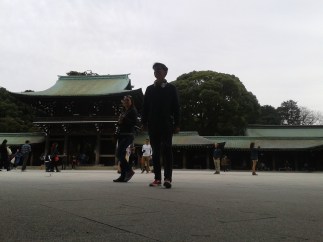


 Hidden Gabe