Part I: Death Stare
Nagasaki is very, very different to Hiroshima. There’s not a chance in hell I’m going over all the stuff I talked about in my last post, but there are a number of things about this city – particularly in regards to its history – that I find a little… unsettling.
I’m currently bolting out of Nagasaki on the Kyushu Line, to join the Shinkansen back to Tokyo at Hakata. That’s a nine-hour train journey right there, so plenty of time to reflect on the four Japanese cities I’ve seen in my time here. To sum it up succinctly, Tokyo was insane, Kyoto was beautiful, Hiroshima was peaceful, and Nagasaki? Well Nagasaki is a total enigma. First off, it’s not particularly pretty. It’s surrounded by some spectacular mountain landscapes, but the city itself is mostly concrete with the odd cobbled street thrown in. Kyoto, untouched by the war and full of ancient shrines, has a mysteriously likeable imperial feel to its aesthetic set-up. Hiroshima too had an almost-Scandinavian quaintness to it with small sidestreets, tree-lined avenues and a calming atmosphere. Tokyo is a sprawling monster of a megalopolis but even that had a certain something about it, just by the sheer force of its visual intensity. Nagasaki, meanwhile, is nothing to look at. Though the natural bay it sits in is absolutely stunning, the fact that it sits here also means it’s a big churning industrial port that never sleeps – its proximity to both China and South Korea means gigantic ships come and go at all times of the day and night. Combine that with a city centre that is about as grey and boring as possible and you have a pretty boring city aesthetically.
That is not to say that the city itself is boring. Far from it, in fact. And yet, it’s the first place I’ve been that I’m not sure I’ve liked because of that fact. Nagasaki constantly keeps your mind ticking. Sometimes it’s when you’re going up the side of a mountain in a cable car, sometimes it’s when you’re getting a boat across the harbour, and sometimes it’s when you’re near anything related to the bomb.
Oh, the bomb. How much you have ruined this city. Not only am I sure it was once a pretty little harbour town, but I’m also sure it was once populated by sane people. The bomb changed both of those things. Remember how I said it felt like Hiroshima had come to terms with their bomb and had moved on to promoting peace? Nagasaki pretends to do the same, but it’s total bullshit and I don’t buy it for a second. I don’t mind this city as there’s enough to do aside from bomb-related things, but anything regarding the bomb just made me furious.
Before I came to Nagasaki, I met many people in Japan who said they’d also liked to have gone but that it was too far away, or they didn’t have time. I met one person who heard from someone who heard from someone who had once gone, that Nagasaki is still very angry about the bomb, in a way that Hiroshima isn’t. I thought that couldn’t really be right, and that it was just something people would say because nobody else has been to Nagasaki to prove it. But holy shit were they right. The Nagasaki Atomic Bomb Museum, which is far more developed and flashy than its Hiroshima counterpart, is like – and I’m not joking – stepping into North Korea. It is so laden with anti-American sentiment and cloying, sentimental, self-pitying bullshit that I literally couldn’t believe they were getting away with it. We all know the bombing was a bad thing, whether it ended the war or not. Even if it was our best option and gave us the optimal conclusion, that doesn’t mean it was a good thing. Yet the museum at Nagasaki acts as if the Allies dropped the A-Bomb for shits and giggles, like they were all sitting around at Potsdam chuckling to themselves over their brandy until Churchill got drunk enough to dare Truman to drop it on Nagasaki.
What this museum did that Hiroshima’s did not do was discuss the context of the bomb. Or at least it attempted to; it had a giant wall devoted to a timeline of the history of the atomic bomb, but it only showed the progression of the Manhattan Project, not its correlation to the war. If you didn’t know already, it would have looked like the Americans were just blowing shit up in the Nevada desert for fun and then randomly dropped it on Japan for no reason. The timeline made it look like there was no war.
Or that was until the last panel. Two big photos sat side by side; one of Harry S. Truman, the other of US Army General Thomas T. Handy. Handy’s photo had a big caption that pointedly and accusingly read ‘Thomas T. Handy – the man who gave the order to drop the bomb’. Truman’s photo was captioned with a quote from just after the bombing; ‘We have used [the bomb] in order to shorten the agony of war, in order to save the lives of thousands and thousands of young AMERICANS‘. Just like that, with the word ‘Americans’ emboldened and capitalised, as if to say ‘Look at these evil allies, only caring about themselves!’. It’s war, genius. Every man for himself.
Don’t get me wrong, I totally appreciate the gravity of the situation being discussed here. As I stated earlier in the week, the bombs indiscriminately killed hundreds of thousands of people. It is both morbidly fascinating and stomach-churningly disturbing to look through the artifacts laid out in the museum, like the row of children’s lunchboxes that have been melted, or bone fragments fused to brick, a two-foot thick iron girder bent out of shape like spaghetti. It really hits home the insane destructive power of the bomb, and highlights that yes, we really did make people suffer and that is something that can never be erased from history.
Yet if you were to look at from the other side, using this museum as a proxy, you’d think it was all for nothing. By playing itself up as the victim, Japan whitewashes its history leading up to the bomb. We bombed Japan because the Japanese were refusing to surrender. We dropped the bomb because, whether they agree with it or not, we truly believed we would be saving more lives. I understand it seems like ‘special treatment’ in a negative way, because it was; that type of bomb should never have been used on people.
But Nagasaki isn’t interested in what we think. Hiroshima, with dignity and patience, debated the morality of the bombing with great philosophical endeavour and intelligence. Nagasaki comes out all guns blazing. Hey look at this photo of a kid with a melted face. Hey look at this letter a mum wrote to her dying baby. Hey look at this really sad testimony of a man whose wife died. I don’t come to museums to be told what to think, thanks. I know enough about this subject to know that the curators should have been far more restrained and respectful – by showcasing images of the dead in such an exploitative, tasteless fashion it not only degrades the subjects, but negates the whole point of discussing the bomb at all. If you cannot internally debate the ethics of the bomb, you should not talk about the bomb, full stop.
And then on to what I found to be the most outrageously offensive thing about this museum; its patrons. I was the only westerner in there, which is fine – you’re the only westerner in most places you go in Japan. That’s not the issue. The issue is this; at Hiroshima’s museum, we were stood around looking at a scale model of the city, with coloured lights being flashed onto it to denote shockwaves and fireballs etc, to demonstrate scale. Everyone stood hunched over the model in concentrated, respectful silence. Put the corresponding Nagaski model in the museum in that city and what happens? A bunch of bullshit is what happens. In the most absurdly un-Japanese fashion possible, the room turned into Kim Jong-Il’s funeral; gasps and yelps of despair suddenly lit up the room just as the spotlight lit up mini-Nagasaki in a bright orange glow. I looked up to discover that all of the women and girls present, which comprised just over half the people standing around the model, were crying.
This is a scale model of a city with a light on it. Save your crocodile tears for the photos of dead babies if you’re going to so openly play your victim card. I do not care how heartless any of this sounds – I’m not having this melodramatic nonsense – and if you were there you too would’ve seen how incredibly fake it all was. Although it’s a bit odd to say, I think realistically we all know what real crying sounds like, and trust me, this was not it. Also, this model city is the first thing you come across as you walk into the museum. It’s literally 5ft inside the front door, and already you’re all bursting into tears of grief? Looks suspiciously like you turned up ready to cry on demand, considering literally every single Japanese person in the museum at Hiroshima could keep their emotions in check; even if they secretly wanted to drop a million bombs on the US as revenge, they quietly wandered about, respectfully observing the exhibits and not openly showcasing how they felt about it. Funny how they managed that while you guys in Nagasaki couldn’t make it three strides through the front door before having a public breakdown.
And so I walked around getting a lot of something I would end up getting rather used to; the death stare. From what I could gather, and perhaps understandably, Nagasaki-ites don’t like Americans. Problem is, they also appear to think that anyone who looks vaguely western is American. I would walk around town and talk to people in shops/restaurants, and most would either shoot me a look that could kill a man, or ask me if I was American. Yep. Not ‘Where are you from?’, but ‘Are you an American?’. I got this maybe seven or eight times during my time here. I would always say ‘No. I’m English.’, which usually brought about a big smile of relief and an ‘OK!’ symbol with their hands (like we had nothing to do with bombing). However, when a cashier at a 7/11 in town frowned at me as I got to the counter asked me the same question again, I lost it. You’re working in a chain convenience store, don’t ask your customers shit like that. ‘Are you American?’ echoed down the noodle aisle, and with a big smile on my face, I said; ‘No I’m not a goddamn American but I can become one if you don’t mind your own business and serve me the coffee I asked for’. He had absolutely no idea what I said. I don’t really have any idea what I meant. There was a pause, and with a look of defeat I said ‘English’, to which his face suddenly exploded into a grin – ‘OK good!’ he exclaimed and he ran off to get my coffee. Good? It’s good that I’m English and not American? I’m loathed to be too self-righteous about this sort of thing, but if the positions were switched and I said ‘Are you Korean?’ and was visibly relieved when he told me he was Japanese, wouldn’t that be considered fairly racist?
Back in the museum, I was reaching the final few exhibits. I got to the end of the interactive exhibit room where I found a small corner with a couple of touchscreen TVs in it, and a series of buttons numbering 1-5. I looked up at the contents. Button #3: Sino-Japanese War. Aha! I’ve finally found some discussion of historical context for the bomb.
‘… the hard-fought war between Japan and China continued as Japan took more territory from the Chinese, culminating in the Japanese taking the city of Nanking, where they committed a massacre’.
… That’s it? Seriously, that’s all you can say about the Rape of Nanking? You can devote an entire multi-storey museum to the suffering caused by the atomic bomb, but all you could muster up for one of the worst war crimes in the history of humankind is half a sentence on a screen hidden in the corner? Oh yeah you looooove going into gratuitous gruesome detail about the things we did to you, either beating your chest as a show of nationalistic defiance or weeping like little bitch, but when it comes to your atrocities, you hurry the narrative along as it suits you. Tell me, where are all the women from earlier? Why aren’t they here, huddled around the screen, crying for the rape, torture and murder of hundreds of thousands of innocent Chinese men, women and children? Where are their tears now? Seems like their tear ducts dried pretty sharpish.
The bomb caused unimaginable pain, suffering and heartache. As someone born in a country that was on the opposing side to Japan and facilitated the bombing more than any other country outside the US, I am openly willing to admit that. It was awful. Of course it was, and it was our doing. But why can’t this museum treat me with the same respect? To this place, the bomb was 100% wrong, the Rape Of Nanking is just a footnote, and the Americans are the very essence of evil. If anything it was that very brutality that the Japanese military showcased in China that led to the dropping of the bomb in the first place; by looking at past behaviour, Truman could tell they weren’t going to give up without drastic measures being taken, even if they were on their last legs by August 1945. They were going to fight – mercilessly so – until all their soldiers were dead.
And yet, what really hurt me more than anything was that the people that were crying the most, and making the biggest show of their grief, were my age. Mid-20s at the oldest, early teens at their youngest. What were they weeping for? I bet their grandparents barely remember the bomb, let alone them or even their parents. By contrast, the two oldest people in the museum- the only couple present who looked old enough to have potentially been able to remember the bomb – did and said nothing. They just observed silently.
To me, this symbolised a really dangerous precipice that Japan is sat on. As I said in my last post, the Japanese education system has faced criticism recently for whitewashing Japan’s war crimes out of its national curriculum, including the events at Nanking, and the infamous Unit 731. Were these kids, stood across the room from me, not being told about these things? And what sort of bizarre nationalism had they been force-fed to persuade them to stand weeping in public in such an incredibly inauthentic fashion? It was an absolutely surreal, confusing and, above all else, grossly insulting sight.
And on the flip side, the museum was always going to be fighting a losing battle trying to make me feel guilty. I’m the same age as the people with tears streaming down their face at what they perceive to be a great injustice – born a full 46 years after the bomb was even dropped. My country might have dropped the bomb, but I sure as shit didn’t. I mean Jesus Christ, I shouldn’t have to say it but it would be the same as me expecting a German my age to feel guilty about the Holocaust. I’m self-aware enough to know it would be an utter embarrassment to even think that, and it is that exact lack of arrogant self-awareness that will forever taint this museum in my memory.
The city of Hiroshima has come together as a community, and tried to heal its wounds with a graceful acceptance of the horror of the Second World War. Nagasaki has done no such thing. Nagasaki was handed an unenviable place in the history books, so it ripped out the page, burned it and wrote its own. I hurried through the remainder of the Nagasaki propaganda museum, gave back my headset, went the memorial hall, bowed to the cenotaph (I’m not going to hold this museum’s twisting of the truth against those who were killed), and promptly left.
* * * * *
Part II: Big Man

One thing Nagasaki definitely has going for it is trains. Being positioned at the very far western end of Japan, you’d think it’d be a simple one-line terminus. Oh no. Nagasaki’s got a bunch of lines branching off all over the place. Including, I discovered, the Ōmura Railway, a cute little two-car train that runs up and down the northwest coast of the island of Kyushu. Which, as it turns out, is absolutely spectacular. I discovered that in the period after the war, the US had an army base in the small seaside town of Sasebo, about two hours up the coast from Nagasaki by train. In 1950, they officially introduced the burger to the Japanese. As a result, it’s now known as ‘Burger Town’, and has a group of restaurants that all make their own special burgers. Hungry and a little bored, I took the coastal line all the way up to Sasebo to check out what it was like (plus after the museum I was not in the mood to hang around Nagasaki until I’d calmed down). The Ōmura Railway, leading from Nagasaki, snaking around Ōmura Bay to Sasebo, is one of the most scenic train journeys I’ve ever been on. Looking out across the water to the mountains on the far side of the bay was a sight to behold, punctuated by tiny little fishing towns with a one-way train line meandering through them.

Then I got to Huis Ten Bosch. Yes, despite being a ‘town’ in Japan, it has a Dutch name, but all will become clear in a moment, for Huis Ten Bosch is maybe the weirdest example of Japanese audacity and abnormality I had seen so far. Listed online as a theme park, it has no real attractions. Instead, it is an exact replica of a Dutch town. With shops. And restaurants. You pay £40 to get in, and then you’re just… in a town. It’s like a holiday for people who can’t pay to get to the Netherlands. Balls to paying that much, so I just peered in as we skidded past on the train – it was absolutely bizarre. Little cobbled streets, a neo-gothic clock tower, and a palace modelled on the Huis Ten Bosch Palace in The Hague, Netherlands. What on Earth was the point in this? Well, I looked it up, and it was something along the lines of ‘to strengthen ties between the two nations’. Really? You could just hold a meeting of leaders or do a state visit, you don’t have to go batshit insane and replicate an entire town. It’s like the diplomatic equivalent of a serial killer tearing off someone’s face and wearing it as their own.
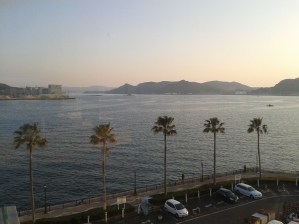
I got to Sasebo, which is a fairly unremarkable little town, and found a ‘burger map’, listing each place and their speciality burger. I chose one called Big Man, simply because of its name, which did a bacon & egg burger with special homemade Japanese mayonnaise. My kind of burger. I wandered over to discover that it was a tiny little place with about four places to sit. I took the only available seat and had my truly excellent, juicy burger with some fries on the side and a pot of their mayonnaise for them. Holy shit that mayo. It was absolutely spectacular. I’ve only ever had better mayo in Belgium, and that is saying something. Who’d’ve thought the most remote corner of Japan would be the home of mayonnaise that bloody good? I certainly didn’t, but by sitting in Big Man with my fantastic food, overlooking the harbour as the sun went down, I had given myself one of the highlights of my trip.
I also decided that I would spend all my time in Nagasaki alone. Which has been quite fun, but also pretty challenging. Very few people speak English in Japan, and even fewer do in Nagasaki. Plus, romaji, Japanese written in the Latin alphabet, is pretty much nowhere to be found around here, so I can’t even tell where I’m going or what I’m doing most of the time. However, every once in a while you find some English translations that are absolute gems. I found a pachinko arcade (a type of Japanese gambling arcade) with this written on the front door;
“Ladies and Gentle man,
Buckle your belt, the adventure is about to commence.
It is in our nature to serve you with excitement and your fun,
so we will be learning much about the universe in this place.
What joy! What fun! What good! Enter at once!”
It’s an arcade, not the space shuttle. Relax. Trust me, you have no idea how much I wish I’d gotten a photo, but my phone battery was too low. I had to hurriedly write it down on my arm with a pen from my laptop bag for all to see. Also on that note when I was in Kyoto I had a subway map that accidentally referred to it as the ‘Kyoto dubway’.

This morning I had to get up at retard o’clock to make my reservation for a tour of Hashima Island. Hashima Island (also known as Gunkanjima – ‘Battleship Island’) is a miniscule-yet-notorious island about half an hour off the coast of Nagasaki. In 1810, this tiny little lump of land sticking out of the Sumo-Nada Sea was discovered to be totally surrounded by undersea coal deposits. By the end of the century, it had been developed into a huge mine, contained around 5,000 workers, and the island had been artificially expanded to about three times its original size. In order to house the workers, Japan’s first ever high-rise apartment blocks were built on the island. At that point it had a population density nine times that of Tokyo. This island is literally about 100ft x 400ft. For 5,000 people to live there is crazy. Then in 1974, due to a mixture of coal going out of fashion and it being an insanely dangerous mine stretching to 350m below the seabed, it was closed. The workers moved back to Kyushu, and the island was abandoned. And it’s stood like that ever since – a partially-ruined mess of apartment blocks, mine shaft entrances and shrines. Half the buildings have collapsed, and the remainder are just concrete shells. Pretty cool stuff.
In fact, so cool and such a part of the country’s industrial history is the island that in 2015, Japan submitted it to UNESCO for approval as a World Heritage Site. At which point South Korea and China both went ‘Hey isn’t that the island where hundreds – if not thousands – of Chinese and Korean forced labour workers were kept under appalling conditions?’, to which UNESCO responded with ‘Yo Japan is this shit true?’. Japan offered a half-hearted acknowledgement of the issue, and that’s all UNESCO needed; they passed it later that year. I should probably add that North Korea also took issue with the proposal, but North Korea bitching about forced labour? Gimme a break. Then again you could probably say the same of China. God, who knows.

The island was cool, to be fair. It’s a little expensive to get to and the sea on the way out is choppy to say the least, but it’s still worth seeing. One problem is that you absolutely cannot stray from the guided group, and you can only stand in three designated ‘viewing points’, all of which are squished at the western end of the island. Which reminded me of how, when I was in Tallinn, Estonia, I went to Paterei Prison, which was surprisingly similar – an abandoned former prison that was left to ruin – you could pay €3 entry to just go in and mess around. You could go into any building, climb any ladder, walk on any rooftop. Nothing was off limits. I mean, the Japanese approach is the more sensible, but be honest, which sounds the more fun?
Lo and behold, neither my guide, nor the English-language leaflet I was given on the island, mentioned any form of human rights abuses. What a surprise. They just talked about the depth of the mine, the danger of working in it, and the living conditions, which they seemed to suggest were rather good. Buuuuullshit my friend. I personally loved this note from the leaflet;
“Completed in 1958, the Hashima Hospital and Quarantine Ward was built to protect the health of the mine workers who risked their lives in the pit, and the families living on the island. For the people on Hashima, the existence of this hospital was undoubtedly reassuring.”
 Oh yeah I can just imagine being kept to do forced labour on a shitty little concrete island, thinking ‘well at least if I get hurt doing this incredibly difficult and dangerous job I’m literally being forced to do, I’ll be saved from the sweet embrace of death!’ Also ‘their families on the island’? Somehow, I doubt the Chinese and Korean workers were that lucky. I also get the feeling these workers probably didn’t feel the full benefit of what was – according to the leaflet – the extremely beautiful, calming rooftop flower gardens on the island. We sped back on the boat across the sea, making some nice jumps on the way. I got to the harbour, went to the hostel to pick up my suitcase (which now has no wheels rather than one), and, after an epic slog across town, carrying the suitcase on my head, I got on the Shinkansen.
And so ends my time in Nagasaki. It’s been weird and wild and I’ve had a lot to say about it. The night view from the top of Mt. Inasa was mind-blowing, Hashima Island was intriguing, and the museum was many things, but at least it wasn’t boring. One more night in Tokyo, then I fly to Singapore. I’ll do another blog post as a perspective piece on my experience of Japan as a whole before I leave.
Wow, that was a long post.
Gabe





 Hidden Gabe